
On October 23, the owners of the Granada Theater and Sundown at Granada announced they are leaving Greenville Avenue. Mike Schoder and Julia Garton had been there, by their own count, for 34 years. Somewhere in those decades is the single best piece of footage Lower Greenville never shot: the two of them explaining, on camera, why they did it. That absence is the reason this guide exists, because the first question in East Dallas interview video production is not what camera we bring. It is whether the thing worth keeping is a person talking or a place moving.
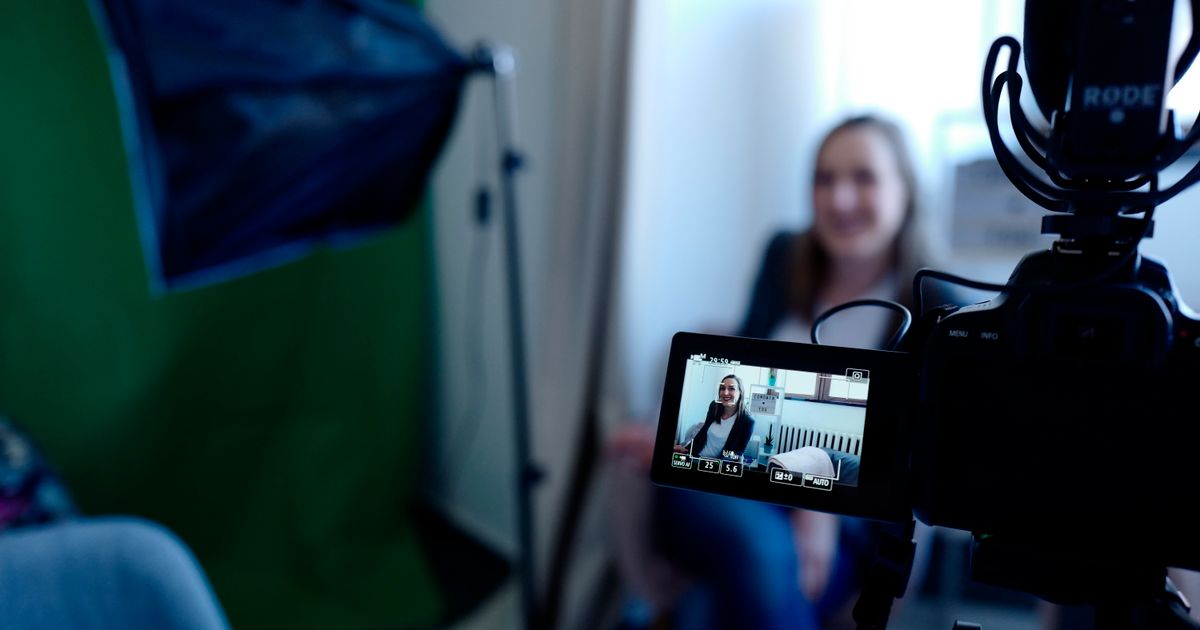
Most owners in Lakewood, Lower Greenville and Knox-Henderson ask us for “a video.” What they usually mean is one of two very different films with very different jobs. Here is how to tell which one your business actually needs, and what it costs you in time rather than money.
Table of Contents
- What Greenville Avenue just taught us about footage
- Interview film or promotional film: the honest difference
- Six tests for choosing between them
- Why the interview holds up longer in Lakewood
- When the promotional film is the right call
- How we shoot an owner interview that does not sound like an ad
- Frequently asked questions
What Greenville Avenue just taught us about footage
The specifics matter here, so take them from the people who reported them. The neighborhood paper, the Lakewood/East Dallas Advocate, published the owners’ statement on October 23, 2026: “For 22 years at Granada and 15 years at Sundown, we’ve poured our hearts into these places.” Sundown’s last day of regular service is November 1, with private events continuing to the end of the year. CultureMap Dallas reports that the Granada itself will close on April 17, 2027, and that the site is bound for a New York spa concept called Bathhouse.
Schoder’s own explanation is worth reading twice if you own a storefront on this street. “Rising costs, shifting audiences, and corporate consolidation have made life increasingly difficult for independent venues,” he said, adding that he had been through the same thing once before with CD World, the record store he opened on Greenville Avenue in 1992 and closed in 2008.
Two independent businesses, 34 years, one street. Everything that made them worth going to lived in the owners’ heads. The merchandise is sellable. The story is not, unless somebody filmed it.
This is not a sentimental argument. It is an asset argument. A promotional film ages with your menu, your fit-out and your prices. An owner interview ages like a deed. When the lease changes, the sign changes or the concept changes, the interview is the only file in the folder that still explains who you were to a neighborhood that will ask.
East Dallas interview video production: the honest difference between the two films
Both formats get called “a brand video,” which is how owners end up paying for the wrong one. The distinction is simple once you name it by what it contains.
An interview film is built on a person speaking to camera. One or two people, a real chair, a real room, questions you actually answer. The footage of the space exists to illustrate what is being said. Nothing in it is scripted, which is why it survives contact with a skeptical viewer.
A promotional film is built on movement and rhythm. Product, hands, light, a track, maybe a line of voiceover. It is made to be scrolled past and still land. Nobody confesses anything in a promo, and nobody expects them to.
Both are legitimate. They do not substitute for each other, and in our experience the costly mistake runs one direction: a business with a genuinely good origin story spends its whole budget on a montage, then has nothing to say when a customer asks who runs the place.
Six tests for choosing between them
Run your business through these. If you answer yes to four or more, the interview is your anchor piece and the promo is the follow-up.
- The name test. Do regulars know the owner’s name? On Greenville and in Lakewood this is often yes, and it means a face carries more than a logo.
- The why test. Is there a real reason this business exists in this specific place, beyond a vacancy and a rent number? If the answer takes ninety seconds to explain, that is the film.
- The succession test. Is there any chance you sell, retire, hand off or relocate in the next five years? If yes, the interview is documentation, not marketing.
- The price test. Do you charge more than the chain two blocks over? Premium pricing needs a human justification, and a montage cannot give one.
- The approval test. Will you ever stand in front of neighbors, a chamber, a landlord or a city commission and need them to believe you? Keep reading on that one.
- The turnover test. Does your product change faster than your story? If the shelf refreshes monthly, the promo is a recurring cost and the interview is a one-time investment.
That fifth test is more concrete in this part of Dallas than owners expect. Late-hours permission on Lower Greenville is granted business by business, with conditions attached. The city’s own record for one Greenville Avenue restaurant, published in a 2011 City of Dallas ordinance, granted Specific Use Permit No. 1881 inside Planned Development District No. 842 and required the operator to “obtain a certificate of occupancy for a late-hours establishment before operating after 12:00 a.m.” It allowed operation only between midnight and 2:00 a.m., required that “all customers must be removed from the Property by 2:15 a.m.,” and terminated automatically four years later.
Read that as a camera brief rather than a zoning document. On this street, a business that wants to stay open late has to be a known, trusted, specific operator in front of people who live nearby. An interview film is the only video format that makes that case. A promo cannot testify.
Why the interview holds up longer in Lakewood
Lakewood rewards longevity in a way that newer Dallas retail districts do not, and the paperwork shows it. The city’s landmark nomination form for the Lakewood Theater at 1825 Abrams Road, prepared in October 2015, records that the theater “opened on October 27, 1938” and asks the Landmark Commission to deem it meritorious of designation. That opening date is 88 years ago today.
The commercial strip around it is older still. In 2017 the Advocate reported that the 67,000-square-foot Lakewood Shopping Center had changed hands again, after being held by Lincoln Property Co. since 2011, and traced the center’s origins to the drugstore “Doc” Harrell opened in 1924.
A district with a hundred-year commercial memory treats a new business as provisional until somebody vouches for it. Film your owner explaining the first year and you have skipped ahead. This is the quiet reason an owner interview outperforms polish here: the audience is not asking whether you look expensive. They are asking whether you are staying.
It also travels further than owners assume. Advocate Media describes itself as “a nonprofit focused on providing hyperlocal news, written by neighbors for neighbors,” and that is roughly how neighborhood attention works offline too. A clip of a real person saying something true gets forwarded inside Lakewood, Knox-Henderson and Bishop Arts in a way a product edit does not.
When the promotional film is the right call
Plenty of East Dallas businesses should put their money in the promo, and we say so before quoting. Choose it when:
- The product is the story. A Deep Ellum shop whose appeal is the object in the window needs the object, close, in good light.
- You are opening, not explaining. Pre-launch, there is no track record to interview about. Shoot the space and the craft, then come back in a year for the interview.
- The owner genuinely does not want to be on camera. Forcing it produces the worst footage we make. A strong promo beats a reluctant interview every time.
- Your calendar is the business. Venues and event-driven operators need volume and recency, which is a different production rhythm. Our breakdowns of East Dallas festival video production and East Dallas gala video production cover how those deliverables are planned.
The practical answer for most owners is sequencing, not choosing. One interview shoot, then promotional content you can keep making. If one of those shoots is a presentation in a booked room, the venue’s own audio visual package shapes the result more than the camera does, which is the subject of our guide to filming a presentation in an East Dallas venue. Here is a company story we produced ourselves, so you can hear what an interview-led film sounds like when it is cut properly:
How we shoot an owner interview that does not sound like an ad
The failure mode of this format is a business owner reciting their website. Avoiding it is most of the craft, and it is why East Dallas interview video production is a different job from pointing a camera at a nice room.
We do not send questions in advance. We send topics. Rehearsed answers arrive pre-flattened, and no edit recovers them.
We shoot in your room, not ours. Our studio at 4925 Greenville Ave is five minutes from most of these blocks, but the back of your own shop, closed, in the morning, is the better set. The light is yours and so is the posture.
We start with the boring half hour. The usable material almost never comes first. Expect forty-five minutes of conversation for ninety seconds of film, and expect the best line to arrive after you think we are done.
We cut the brand language out. If a sentence could appear on any competitor’s homepage, it does not survive the edit. What stays is specific: the year, the street, the mistake, the number.
We get the handoff version. One question we always ask is what you would want a new owner to understand. Nobody enjoys it and everybody answers it well. Four days after the Granada news, that question needs no defending.
Frequently asked questions about East Dallas interview video production
How long does an owner interview shoot take?
Half a day on site is typical, with roughly an hour of that spent actually interviewing. We shoot supporting footage of the space in the same visit, so you are closed or quiet once rather than twice. Edits are usually delivered within two weeks.
What do I actually get at the end?
Normally a 90-second anchor film for your homepage and Google Business Profile, a longer three to four minute cut for anyone who wants the whole story, and four to six short vertical clips pulled from the same interview. One shoot, three formats.
I am not comfortable on camera. Should I skip it?
Tell us that first and we will plan around it. Some of the strongest interviews we have shot came from owners who were nervous, because nervous people stop performing. If it is a firm no, we build a promotional film instead and nobody loses a day.
Can an interview film help my business get found in local search?
It helps, indirectly and modestly. Video keeps people on your page longer, gives you fresh media to post to your Google Business Profile, and earns the kind of neighborhood links and shares that local ranking responds to. It is one input among several, not a switch.
Is this different from a generic Dallas video package?
In the preparation, yes. The questions that work in Lakewood are not the questions that work in a corporate park, the permitting and late-hours realities on Greenville Avenue are specific, and a crew that has loaded in on these blocks before loses less of your morning to parking. That local knowledge is what we mean by East Dallas interview video production rather than a Dallas package with a neighborhood name on it.
Ready to get your owner on camera?
Tone Films is a director-led East Dallas video production company with a studio at 4925 Greenville Ave, minutes from Lower Greenville, Lakewood, Knox-Henderson, Deep Ellum and Bishop Arts. We shoot owner interviews and promotional films for independent businesses that want footage worth keeping, not just footage worth posting.
Tell us about your business and we will come back with a fixed fee within one business day. See our East Dallas video production services, browse our portfolio, or get in touch here. If your story is 22 years long, this is a good month to put it on record.
About the author — Andrei Tone is the founder and director of Tone Films, a video production company with studios in 45 U.S. cities. He has directed films for police and fire departments, 9-1-1 districts, school districts, hospitals and brands including Disney Junior and Cuisine Solutions.


