
Roughly half your attendees will never sit down in the general session. Freeman’s April 2026 attendee research — 4,700-plus attendees and 185 organizers — found that about 50% participate in keynote or general sessions, and that when you ask attendees where they would ideally spend their learning time, 54% of it falls outside traditional session rooms altogether. That one pair of numbers should reframe what Seattle conference video production is actually for. The highlight reel is not the deliverable. The session library is: the recorded breakouts, panels and workshops your members open in October, for a meeting that ended in May.
And in Seattle, building that library is a logistics problem long before it is a camera problem. This city’s convention campus is not one building. It is three addresses, roughly 140 meeting rooms, and a walk uphill in between.
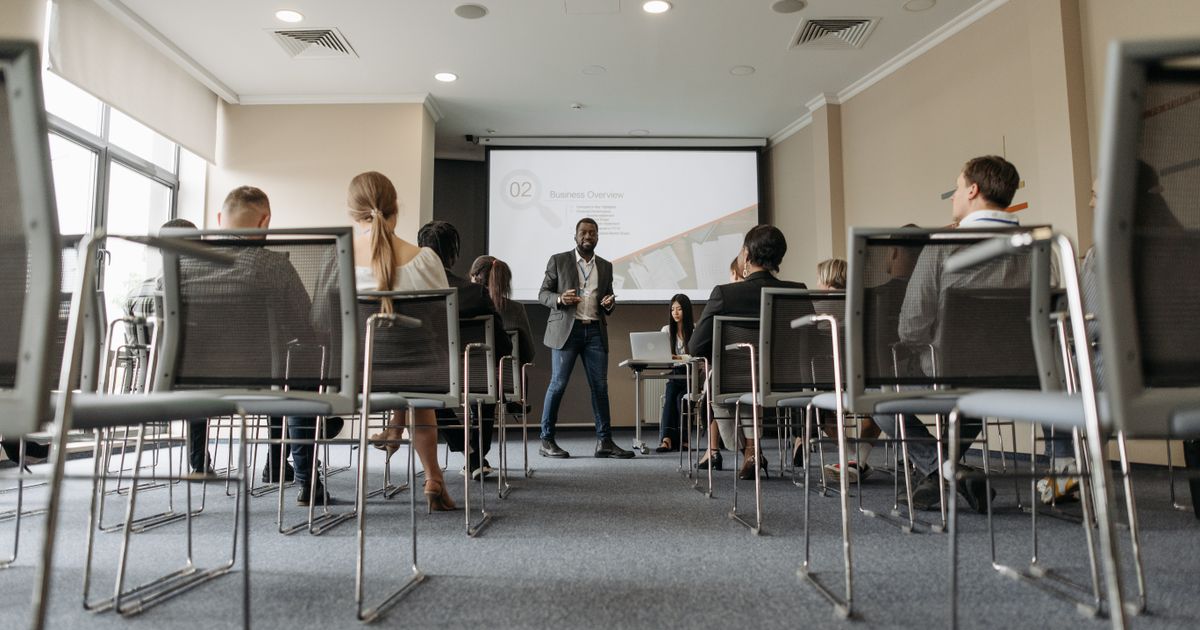
Table of contents
- The session library is the real deliverable in Seattle conference video production
- Why Seattle conference video production starts with a room list
- Audio decides whether a recorded session is usable
- The permissions you settle before you publish
- When the program leaves Pike and Pine
- A three-day Seattle conference video production plan that survives the schedule
- Seattle conference video production FAQ
The session library is the real deliverable in Seattle conference video production
Meetings professionals have been trained to think of conference video as a three-minute sizzle: crowd shots, a lanyard close-up, a happy exhibitor. Seattle conference video production budgets get approved on that film. It has a job, and it is a small one: selling next year’s event to people who already came to this one.
The content that earns its budget is the session recording. Freeman’s July 2026 follow-up report, drawn from more than 3,300 attendees and exhibitors, found that 70% of attendees rank in-person events as their primary learning channel — above webinars, on-demand platforms and social media. They are coming for the content. The question is whether your organization still owns that content on the Monday after.
“Learning doesn’t begin when attendees sit down in a session, and it doesn’t end when they walk out of one.” — Ken Holsinger, SVP of Strategy, Freeman
It is worth being honest about what that library is not. Fewer than 20% of attendees name continuing-education credit as a top reason for coming, so “we need it for CE” is rarely the whole business case. The stronger case is simpler: a year of member value, a year of marketing assets, and a year of proof for the sponsors who paid to be in those rooms.
Why Seattle conference video production starts with a room list, not a day count
Most requests for Seattle conference video production arrive phrased as days. “We need a crew for three days.” That is the wrong unit. The unit is the room.
One campus, two buildings, a block and a half apart
The Seattle Convention Center campus is split across three addresses. Summit at 900 Pine holds 574,630 square feet of event space, including 248,590 square feet of exhibit space, 62 meeting rooms and a 58,650-square-foot column-free divisible ballroom. Arch at 705 Pike carries 205,700 square feet of dedicated heavy-load exhibit space, 61 meeting rooms, four ballrooms and six exhibit halls. Arch at 800 Pike adds another 17 meeting rooms and 35,000 square feet of carpeted meeting space.
The convention center’s own campus guide describes Summit and Arch as a block and a half apart. On paper that is nothing. In practice it is a public sidewalk on a Seattle hill, two sets of freight elevators, a loading dock with its own schedule, and gear carts that cannot simply be wheeled through a crowd of ten thousand people between sessions.
What “coverable” actually means
When we scope Seattle conference video production, we draw a line around clusters of rooms that one operator can realistically hold for a half-day block. Adjacent breakouts on the same floor of Summit are one assignment. A 9:00 a.m. session in Summit and a 10:15 a.m. session in Arch are two assignments, no matter what the budget spreadsheet says, because the turnaround includes a building change.
This is why the room list has to come first. Give a crew the room list and the grid, and the honest answer — how many tracks you can capture, and which ones you are quietly giving up — falls out in about ten minutes. Give them a day count, and everybody discovers the problem at 8:40 on the first morning.
Audio decides whether a recorded session is usable
Audio is the single biggest quality variable in Seattle conference video production, and nothing else comes close. A slightly soft picture of a speaker is a watchable recording. A perfect picture with room-mic audio, an air handler and a coughing front row is a file nobody finishes.
Three things settle it, and all three are decided before the doors open:
- Take a feed from the house mixer, and verify it yourself. Your AV or staging partner is running the room audio anyway. A clean split off their board gives you the podium mic, the lav and the panel mics already mixed. Record it as a discrete track, and record a backup — a board feed that failed silently at 9:04 is not discovered until the edit.
- Decide how Q&A gets captured. Audience questions are where the useful moments live, and they are almost always the worst-sounding part of the file. Runner mics or fixed aisle mics, agreed in advance, or you will be captioning a guess.
- Put a second sound source on every recorded room. An on-camera shotgun or a small recorder at the lectern costs almost nothing and saves the session when the primary drops.
Rooms at Summit and Arch are professionally equipped and the in-house and contracted AV teams here are good, but the audio path still has to be negotiated as part of your capture plan rather than assumed.
The permissions you settle before you publish a session
A session library is only an asset if you can actually post it. A Seattle conference video production plan should settle four permissions before the doors open, because four things routinely stop a recording from going live, and all four are cheap to solve in advance and expensive to solve afterwards.
A speaker release that covers on-demand. Not “we may film the event” — explicit permission to publish that session, in full, on a platform you name, for a period you name. Collect it at the speaker-agreement stage.
Slide rights. Your speaker’s deck may contain a licensed photograph, a chart from a paywalled report, or a patient image. Recording the screen republishes all of it under your organization’s name.
Embargoed or unpublished material. In a market this dense with research and enterprise product teams, some of the most valuable sessions contain things that cannot be public yet. Agree the rule beforehand: either the speaker flags the slides to cut, or that session is captured for internal use only. The same question governs the moment a study’s own findings become the subject, which is why we treat video for Seattle medical research institutions as a separate approval workflow.
Sponsor disclosure. Freeman’s July 2026 report found 84% of attendees view sponsored sessions neutrally or positively when the sponsorship is clearly disclosed — and only 16% negatively. Disclosure is not a tax on sponsored content; it is what keeps it watchable.
Captioning belongs on that list too. Beyond the plain fact that captioned sessions get watched more, the Seattle Convention Center is a public facility: it operates as a Public Facilities District, a municipal corporation formed by King County ordinance in 2010 and directed by a nine-member board appointed by the State of Washington, King County and the City of Seattle. Meetings convened here often have public agencies as co-hosts, funders or exhibitors, and those partners bring their own accessibility obligations to the table. If a city department, a transit agency or a public university is named anywhere on your program, ask early what standard their content has to meet — those deadlines are not uniform, and we set out how they differ between a county department and an independent district in our piece on video for Seattle’s transit and port agencies. It is the same discipline we bring to work as a government video production company for agencies elsewhere in the country.
When the program leaves Pike and Pine: Bell Harbor, Meydenbauer and the hotel floor
Seattle conference video production regularly spans more than one venue. Plenty of Seattle meetings never touch the convention campus, and plenty of large ones spill off it for a board day, a donor reception or a pre-conference workshop.
Bell Harbor International Conference Center sits on Pier 66 at 2211 Alaskan Way, and its Bay Auditorium seats up to 330 in amphitheater rows with built-in hardwood desks — which, from a camera’s point of view, is close to ideal: fixed sightlines, tiered faces, a real stage relationship. Elliott Hall adds 15,000 square feet. It is a waterfront room that records well and needs very little help.
Across the lake, Meydenbauer Center at 11100 NE 6th Street in Bellevue offers 54,000 square feet of meeting and exhibition space, a 36,000-square-foot column-free Center Hall, a 410-seat sloped-floor theatre and up to nine configurable meeting rooms — about nine miles from downtown Seattle. For Eastside-anchored programs, particularly enterprise and technology meetings drawing from Bellevue, Redmond and Kirkland, Meydenbauer often beats downtown on load-in, parking and attendee drive time.
That Eastside pull is no longer limited to conference programs: we looked separately at what the Eastside’s enterprise event calendar asks of a crew, from campus security reviews to the cuts a flat budget has to cover.
The planning consequence is the same in every case: a program split across a downtown campus and an Eastside or waterfront venue is not one crew moving around. Those transitions are their own line item, and pretending otherwise is how a session gets missed.
A three-day Seattle conference video production plan that survives the schedule
Here is what a workable Seattle conference video production plan looks like for a 1,200-person association meeting based in Summit, running four concurrent tracks with a general session each morning.
- Day one. Two operators on the general session in the ballroom — one locked wide for the full-length record, one roaming for cutaways that the marketing team will need later. After the general session, both move to the two highest-value breakout rooms on a single floor. Nothing crosses to Arch on day one; day one is where the schedule is still moving.
- Day two. The deepest day. Four rooms captured, clustered by floor rather than by track importance, plus a two-hour interview window in a quiet room for speaker and sponsor pieces. Those interviews are the cheapest good footage of the whole event and the most reusable.
- Day three. Closing general session, then the awards or member-recognition block. Crew consolidates back to one building. Same-day delivery of one short recap clip, cut from material already logged on day two.
Notice what this plan does not promise: all sixteen breakout slots. It claims ten or eleven sessions captured properly, an interview bank and a recap — and it tells the board in advance which sessions were not recorded, so that is a decision rather than a discovery.
Association work is where this pays off most visibly. Here is a program film we produced for Finseca, a national professional association, covering their management and leadership program:
More of that work sits in our portfolio, alongside the corporate and public-sector films that use the same multi-camera, fast-turnaround approach.
One more piece of context for anyone building a multi-year internal case for Seattle conference video production. Seattle’s meetings business is still rebuilding its base: Hoodline reported in February 2026 that the convention center’s booked events climbed from roughly 160 to 200 while operating revenues rose 25% and its net operating loss narrowed by about $3.8 million. Meanwhile Visit Seattle reported 39.7 million visitors to Seattle and King County in 2025, a 0.6% dip, against $8.8 billion in visitor spending. Translation for a meeting owner: competition for attendee attention is real, and the organizations winning it are the ones whose content keeps working after everyone flies home.
Seattle conference video production FAQ
How many breakout rooms can one crew realistically cover in a day at the Seattle Convention Center?
One operator can typically hold two to three sessions in a half-day block if the rooms are adjacent and on the same floor. The number drops as soon as the assignment crosses between Summit at 900 Pine and Arch at 705 Pike, because a building change eats the turnaround between sessions. We scope Seattle conference video production from your room list and grid rather than from a day count.
Can you record from the venue’s house audio system instead of setting up your own?
Usually yes, and it is generally the best-sounding option — a split from the mixer your AV partner is already running gives you the podium, lav and panel mics pre-mixed. We still record a second, independent source in every room as backup, because a board feed that fails silently is not discovered until the edit.
Do we need a signed release from every speaker before publishing sessions on demand?
You need permission that explicitly covers on-demand publication, not just filming. The cleanest approach is to build it into the speaker agreement at the point of acceptance. We are not lawyers and this is not legal advice, but we can tell you what we have seen stop a library from going live.
What happens when a speaker shows unpublished data or a customer’s confidential slide?
Agree the rule before the event. Either the speaker flags the restricted slides and we cut those segments, or that session is captured for internal use only and never enters the public library. Sorting it afterwards means re-editing on a deadline with a nervous general counsel.
Should we record every session, or choose rooms in advance?
Choose in advance, almost always. Recording everything at a four-track meeting means either a very large crew or a very thin one, and the unwatched files still cost money to store and caption. Good Seattle conference video production is subtractive: pick the rooms with the strongest content and the clearest sponsor or member value, and record those properly.
Work with a Seattle crew that plans by room
Our approach to Seattle conference video production is to build session libraries, not just sizzle reels — and we scope them from your room list, your grid and your venue’s actual geography. If you are running a meeting at Summit, Arch, Bell Harbor or Meydenbauer in the next year, we can tell you quickly what is genuinely coverable and what is not. Our video production team in Seattle works across Downtown, South Lake Union, Belltown, Capitol Hill and SoDo as well as the Eastside. South on I-5, our video production in Portland crew handles Oregon meetings the same way.
If your program is more internal than public-facing, our guide to Seattle internal communications video covers formats for hybrid teams, and there is broader context in how we approach video for Seattle brands more generally.
Tell us your dates and your room list, and we will come back with an honest capture plan.
About the author — Andrei Tone is the founder and director of Tone Films, a video production company with studios in 45 U.S. cities. He has directed films for police and fire departments, 9-1-1 districts, school districts, hospitals and brands including Disney Junior and Cuisine Solutions.


