
Nashville AV video production almost never starts as a video question. It starts as a line on an audio-visual quote — “record of general session, two cameras, files delivered” — and by the time anyone asks whether that will produce something the company can actually publish, the room is booked, the labor is contracted and the answer is whatever the AV package says it is.
That is a fixable problem, but only if you catch it early. This is a decision guide for the meeting planner, marketing lead or association director who has to decide whether the cameras belong to the AV provider or to an independent crew working alongside them. In Nashville that decision is unusually consequential, because this city does not have one meetings market. It has two, and they are governed differently — which is why Nashville AV video production rarely looks the same twice.
On this page
- Nashville is two meeting markets, not one
- “Preferred” is not “exclusive,” and the difference is real money
- What the AV camera package actually buys you
- What an independent crew adds that a record-of-room does not
- Five questions that settle your brief
- Where Nashville AV video production costs diverge
- The public-sector wrinkle and the 2027 deadline
- What Nashville AV video production looks like on our days
- Nashville AV video production FAQ
Nashville is two meeting markets, not one
Most convention cities have a downtown core and a scattering of hotel ballrooms. Nashville has a downtown core and a second, self-contained convention campus ten miles east in Donelson — and the two operate under completely different rules. Anyone scoping Nashville AV video production has to know which one they are in.
Downtown, the anchor is Music City Center, the publicly owned building that opened in May 2013. Its venue profile lists roughly 353,000 square feet of exhibit space and 72 meeting rooms. Around it sits the densest hotel cluster in the region: the 800-room Omni Nashville next door, and at Nashville Yards the Grand Hyatt and Union Station, which together offer more than 700 rooms and about 70,000 square feet of meeting space. Skift Meetings reported in May 2026 that an 817-room Signia by Hilton has been proposed at Nashville Yards, which would make it downtown’s largest hotel.
Out at Opryland, the arithmetic is different in kind rather than degree. Ryman Hospitality Properties puts the Gaylord Opryland Resort & Convention Center at 2,888 guest rooms and 640,000 square feet of meeting, convention, exhibit and pre-function space — the largest non-gaming hotel in the continental United States by meeting space. And it is growing. Meetings Today reported that a $131 million expansion adding roughly 108,000 square feet — a 31,000-square-foot ballroom plus breakout and pre-function space — is scheduled for completion by spring 2027, taking the property to about 756,000 square feet.
Why does this matter for Nashville AV video production? Because a self-contained resort campus and a publicly owned convention center handle in-house services, outside vendors and load-in differently — and who may point a camera at your keynote is answered by whichever one you signed with.
In Nashville, the video decision is usually made in the venue contract — months before anyone in marketing has seen a storyboard.
“Preferred” is not “exclusive,” and the difference is real money
Here is the single most useful fact in this article. When Music City Center announced its audio-visual arrangement with LMG, effective January 1, 2022, the building’s own press release described LMG as the centre’s “onsite, preferred audio/visual partner.” Charles Starks, then the centre’s president and CEO, said in that release: “Audio/Visual services are critical to our business. LMG has been a great partner, and we’re excited to continue that relationship.”
Read the wording carefully. Preferred is not the same word as exclusive, and the announcement makes no claim of exclusivity. That distinction is worth money on any Nashville AV video production budget, because a great many planners assume the opposite and never ask.
What it does not mean is that you can ignore the building. Preferred-partner arrangements still shape rigging, power, floor rates, internet and who may patch into what. The practical move is not to fight the AV provider; it is to read your license agreement and ask the venue in writing: can an outside crew work here, what credentials and insurance must they carry, and what does a clean audio and program feed from the house mixer cost. Get those answers before you price Nashville AV video production, not after.
The same questions apply at Gaylord Opryland and at the downtown hotels, and the answers will differ property by property. Ask anyway.
What the AV camera package actually buys you
An AV company’s camera line item is designed to do one job well: put a picture on the screens in the room and leave behind a recording of what happened. That is a legitimate and valuable service, and on a lot of meetings it is exactly the right purchase — the cheapest good answer to Nashville AV video production is sometimes the one already on the AV quote.
What it typically produces is a locked-off or lightly operated wide shot, cut live to image-magnification, recorded as one long file with the program audio baked in. For an internal archive, a compliance record or a members-only session library, that file is fine — and anyone telling you otherwise is selling.
Where it falls down is when someone later asks for a two-minute recap, a sponsor deliverable, or a clip of the CEO that does not open with a stagehand walking out of frame. The footage was never shot for that. Nobody did anything wrong; the brief was “record the room,” and the room got recorded.
What an independent crew adds that a record-of-room does not
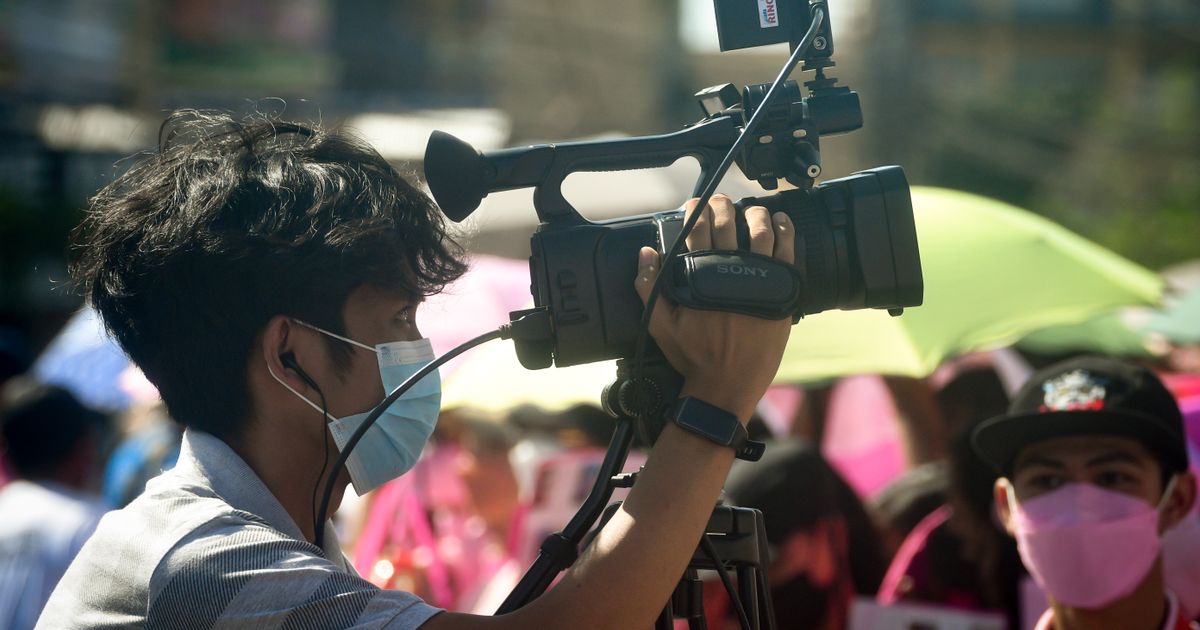
A separate crew buys coverage planned backwards from the deliverable rather than forwards from the room. That is the real dividing line in Nashville AV video production, and in practice it means a few concrete things.
- Shots that exist because an edit will need them. Audience reactions, hands on a product, a speaker’s entrance, the hallway conversation — none of which appear in a locked-off wide.
- Audio you can actually cut. A dedicated split from the house mixer plus an independent backup, rather than one program mix with a dropped lavalier baked into it forever.
- Interviews. The single highest-value thing at any conference is the people who flew in for it. A controlled interview room for two days produces a year of content.
- Turnaround. An editor on site delivers a day-one recap that evening, which is worth far more than the same film three weeks later.
- Ownership and formats. Delivered masters, captioned versions and vertical cutdowns, rather than one long file you have to pay someone else to make usable.
None of this argues against the AV company. On most large meetings the best outcome is both: the house team owns the room, the video crew works off their feed. Good Nashville AV video production is a collaboration, and the AV provider is usually the first call our producer makes.
Five questions that settle your Nashville AV video production brief
Answer these five honestly and the Nashville AV video production question resolves itself. The pattern of answers tells you which way to go.
- Will anything be published externally? If the footage only ever reaches an internal archive or a members’ portal, the AV record is very likely sufficient. If any of it goes on a website, a channel or a sales deck, it needs to be shot for that.
- How many rooms run at once, and does any of it stream? Concurrent rooms and live delivery are crewing questions before creative ones, and they drive cost more than camera choice.
- Does anyone need a deliverable before the meeting ends? Same-day output needs an editor on site with the media — a staffing decision made weeks out, not a favour asked on the last afternoon.
- Have you sold sponsor or exhibitor video? If you have promised a sponsor recap, that is a separate product with its own shot list, and it will not fall out of a general-session recording.
- Who must be interviewed while they are in town? Write the list. More than three names and the interview room pays for itself.
Two or more “yes” answers and you are buying a crew. Zero or one, and the AV package is probably the right call — spend the difference on better audio instead.
Where Nashville AV video production costs genuinely diverge
The comparison people make is camera-for-camera, which is the wrong comparison. The AV record is cheap because it is a by-product of equipment already in the room. An independent crew is a separate scope with its own labour, and pretending otherwise helps nobody.
So compare outcomes, not line items. Nashville AV video production priced as “two cameras” and Nashville AV video production priced as “a recap film, three interviews and a captioned session library” are not the same purchase.
The costs that actually move: crew days multiplied by simultaneous rooms; whether an editor is on site or working after the fact; captioning volume; and venue charges for feeds, power and rigging that appear in neither quote until you ask. That last one surprises people most, and one email to the venue avoids it.
The wider market is moving the same way. AVIXA’s August 2025 forecast put global pro AV at $332 billion in 2025, reaching $402 billion by 2030 at a 3.9% compound rate, and named broadcast AV the second-largest solution area — driven by enterprises wanting real content capability out of their events, not a recording of them. Demand for Nashville AV video production is rising for the same reason.
Locally, the hotel base is deep enough that group business here is steady rather than boom-and-bust. The Nashville Convention & Visitors Corp’s published research records Davidson County hotel occupancy at 67.5% in 2024 at an average daily rate of $201.83 — a year-round market, not a handful of peak weeks.
The public-sector wrinkle and the 2027 deadline
If any part of your meeting involves a Metro department, a state agency, a public health body or a transit authority — and in this city many association meetings do — accessibility stops being a preference and becomes a compliance date.
The Department of Justice’s ADA Title II web and mobile accessibility rule requires covered state and local government entities to meet WCAG 2.1 Level AA. In an interim final rule issued on April 20, 2026, the Department extended the compliance dates by one year: entities serving populations of 50,000 or more now have until April 26, 2027, and smaller entities and special districts until April 26, 2028. The Department’s stated reason was that it had “overestimated the capabilities (whether staffing or technology) of covered entities to comply with the rule in the time frames provided.”
A jurisdiction the size of Metro Nashville falls in the 50,000-and-over group, so 2027 is the operative date for public-sector video published on an agency’s site. For anyone scoping Nashville AV video production with a public-sector partner: agree in the contract who produces captions, to what standard and on what turnaround. Confirm your specific obligation with counsel — the rule’s exceptions and its treatment of archived content are genuinely fiddly, and this is not legal advice.
We do a lot of this work. If your Nashville AV video production project sits mostly on the agency side of that line, our government video production company page covers how public-sector procurement, captioning and public-safety filming actually run.
What Nashville AV video production looks like on one of our days
Conference and corporate-event coverage is core work for us rather than a sideline, and most of it happens alongside somebody else’s AV team. Here is a highlights film we produced for the C-StoreTEC 2025 conference — a multi-day trade event with a general session, concurrent breakouts and an exhibit floor, shot off the house feed:
More of this work is in our portfolio. We cover Downtown Nashville, The Gulch, Germantown, East Nashville, 12 South and the Music Row business district, travel to Franklin and Brentwood for corporate clients, and head out to Donelson whenever the meeting lands at Opryland.
Nashville AV video production FAQ
Can we bring our own video crew into Music City Center?
The building’s own announcement describes its audio-visual partner as “preferred” rather than exclusive and makes no exclusivity claim — but the operative document is your license agreement, not a press release. Ask the venue what an outside crew needs in credentials, insurance and feed access, and get it in writing before you contract anyone.
Do we still need the AV company if we hire a video crew?
Almost always, yes. The AV provider owns the screens, the sound in the room and the show itself, and a video crew works off that infrastructure. Replacing one with the other is how meetings go wrong; running them together is how good Nashville AV video production actually gets made.
What do you need from the AV team on site?
A clean audio split from the house mixer, a program or slide feed if sessions are recorded, comms, and ten minutes in the production meeting. That is most of it. We bring our own power and stay out of sight lines.
Is the AV company’s recording ever good enough on its own?
Yes — for internal archives, compliance records and members-only session libraries it frequently is, and we will say so rather than sell you a crew you do not need. It stops being enough the moment something has to be published externally or cut to length, which is the point at which Nashville AV video production becomes a separate line.
Does a meeting split between downtown and Opryland need two crews?
Not necessarily, but it has to be decided in advance. Ten miles and two different venue regimes make an improvised same-day move expensive. Schedule the move into the crew plan or budget a second unit — both work, and guessing does not.
Talk to us before the AV quote is signed
The cheapest version of this decision is the one made early, while the venue contract is open and the AV scope is still a draft. Tone Films is a Nashville video production company that works alongside AV and staging teams across Music City Center, the downtown hotels and the Opryland campus. Send us the AV quote and we will tell you honestly whether Nashville AV video production needs a separate crew on it.
Related reading: Nashville medical conference video production for clinical and association meetings, and fundraising event video production for gala season. Ready to scope a shoot? Get in touch with our team, or read what a video production company in Nashville should bring to a meeting room.
About the author — Andrei Tone is the founder and director of Tone Films, a video production company with studios in 45 U.S. cities. He has directed films for police and fire departments, 9-1-1 districts, school districts, hospitals and brands including Disney Junior and Cuisine Solutions.


