
What this page covers
- What changed for Austin event staging video production: no building to standardize against
- “We already have an AV team. Why bring in a video crew at all?”
- “Whose audio is it, when there is no house system to split?”
- “Can your crew work inside the call we already have?”
- Austin event staging video production at load in: what we need from you
- “Who owns the files when the show ends?”
- Austin event staging video production when the room changes every year
- Austin event staging video production FAQ
Austin event staging video production is a partner conversation here, not a client one. In most markets a video crew walks into a convention center, asks the house audiovisual provider for a split and a rigging point, and the building absorbs the rest. Austin does not have that building right now. The Austin Convention Center at 500 E. Cesar Chavez St. closed in April 2025, and the city’s own site says it is “closed for construction as part of its planned expansion and redevelopment.” It will not take another citywide until the 2029 festival season.
So the work moved: to the Palmer Events Center, to hotel ballrooms, to the Domain, to rooms never meant to hold a 1,200 person general session. And the party holding it together is not the venue. It is the staging company.
That is why our Austin event staging video production calls now start with an AV or staging project manager asking a version of the same six questions. Here are the answers we give, in the order they come up.
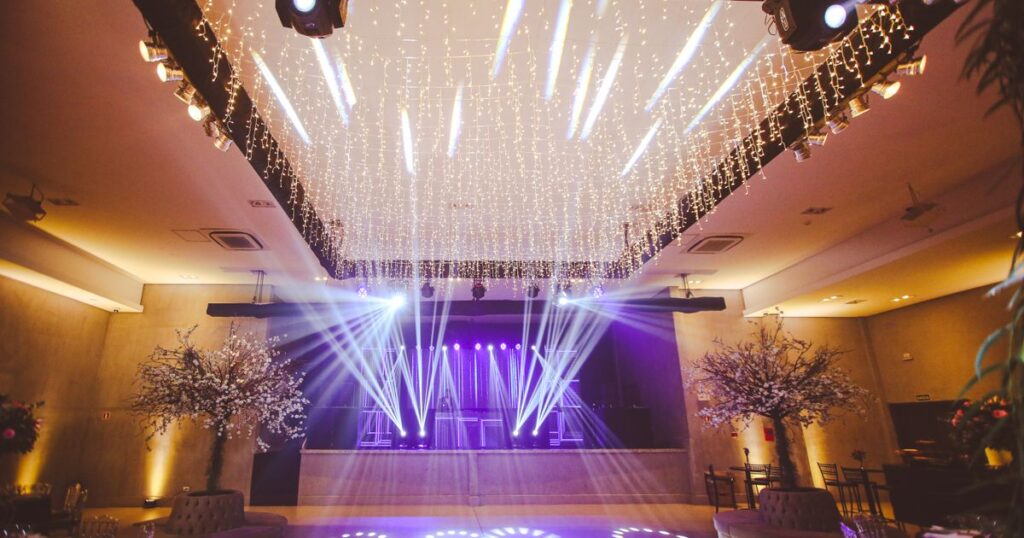
What changed for Austin event staging video production: no building to standardize against
It is worth saying out loud how unusual this is. Community Impact, reporting on the redevelopment design in February 2025, put it bluntly: “Major events will look different in Austin until 2029, as it’s highly unusual to close a city’s center for four years.” For anyone selling Austin event staging video production, that sentence is the whole market condition.
The replacement is a real building, not a renovation. Austin is going, in the city’s words, “from the existing 365,000 square feet to 620,000 square feet” of rentable space in a $1.6 billion project funded through Hotel Occupancy Tax and convention center revenues. Community Impact reported that the old hall offered “less than 250,000 square feet of exhibit space, the 61st-most in the country,” and that its limits “forced the rejection of nearly half of all new event proposals in recent years.”
What matters for Austin event staging video production is the interim, and the interim has two anchors. The first is Palmer. The Austin Convention Center’s own site confirms that “our sister facility, the Palmer Events Center at 900 Barton Springs Road, remains open and available for bookings,” and Visit Austin lists it at 70,000 square feet of exhibit space “that can be divided into two halls,” 131,000 square feet in total.
The second anchor is hotel inventory. Visit Austin counts 51,000 hotel rooms citywide and 15,000 downtown, with more than a million square feet of hotel meeting space across the city. Community Impact reported Visit Austin president and CEO Tom Noonan noting that downtown’s room count more than doubled in a decade, from roughly 6,800 to more than 15,000.
“Austin needed to expand just to remain relative and competitive, even in the Texas market. The competition is fierce for convention business because it’s big dollars.”
Tom Noonan, president and CEO, Visit Austin, to Community Impact
Put those together and the picture for a camera crew is clear. A program that used to sit in one hall with one set of house rules now sits in three or four rooms a year, each with a different vendor map. Austin event staging video production has to be briefed per room, not per city. For the venue side of that same problem, we mapped out filming a conference across Austin’s three hotel collections, where one program’s ballrooms can sit under three different operators.
“We already have an AV team. Why bring in a video crew at all?”
A fair question, with a direct answer: image magnification and a recording are different jobs with different success criteria, and in a borrowed room they compete for the same people.
Your AV team’s job on show day is that the room works: screens lit, presenter audible, breakout starting on time. A camera operator who also owns the IMAG feed will, correctly, protect the room first. The recording becomes whatever was left over, usually a locked wide shot and whatever audio the stage box happened to carry.
A separate video crew is not a comment on your AV work. It is a second set of hands whose only deliverable is the thing that outlives the event. That matters more in Austin right now than it did three years ago, because clients booking a hotel ballroom instead of a convention hall are frequently paying for content to justify the smaller room. Most Austin event staging video production budgets we see are defended on that basis.
- If the client’s goal is attendance, IMAG is the deliverable and your team already owns it.
- If the client’s goal is a session library, sponsor assets or recruitment footage, that is a second crew with its own audio path.
- If the client wants both, decide in the brief who gives way when the room runs late. That one sentence prevents most show day friction.
“Whose audio is it, when there is no house system to split?”
In a convention center the answer is a form. You order a line level split off the house system from the venue’s audiovisual provider and it arrives. In a hotel ballroom running on a staging company’s own package, there is no house system to split. The console is yours, which makes audio the single most common failure point in Austin event staging video production today.
That is better for everyone, as long as it is said early. What we ask for is an isolated post fader feed of presenter microphones, kept separate from program playback, delivered as a discrete channel at line level. Not a mix minus of the room. Not a shotgun on the back camera, which in a divisible ballroom captures reinforcement, reflection and the air handler.
The practical ask in Austin event staging video production is one output and one conversation with your A1. We bring our own recorder and cabling, we label it, and we do not touch your console. When a program also goes out live, hybrid delivery adds a second path to settle, which is the part we broke down separately in our piece on the myths that break a hybrid Austin event.
One more thing worth deciding before load in: who holds the backup. If your package records as a safety and ours records as the deliverable, you can finish a two day program with two libraries, different timecode and nobody sure which one gets captioned.
“Can your crew work inside the call we already have?”
Usually, yes, and the question behind the question is about responsibility rather than headcount. On a show where stagehands are already referred through a hall and your own technicians are on the clock, adding Austin event staging video production to the call raises three things that should be written down rather than sorted out at 7 a.m.
First, who signs for which position. A camera on a riser inside your set is a different arrangement from a camera on a tripod in the house, and it is worth naming which one it is. Second, whether any part of our package leaves the floor. If a camera hangs, it lives on the same plot as your points, approved by whoever approves your points, at the same time. A camera plan that arrives as a separate sketch two weeks later is the version that gets cut.
Third, call times. This one is specific to the Austin calendar. Community Impact reported that SXSW is staying in the city through the interim years, so downtown build weeks still compress hard in March, and again in the fall. A staging company holding three ballrooms in one week does not have a spare 6 a.m. If our focus call has to sit inside yours, we would rather plan the compromise than discover it.
Austin event staging video production at load in: what we need from you
Less than most staging partners expect, with two exceptions that cause nearly all the trouble.
The first is power that is genuinely ours. A recorder, a switcher and an encoder on the same circuit as a lighting kit is a gamble, and the fix mid show is not a fix. In a hotel ballroom this is a question for the staging company, not the venue, because you already ordered the distro. One dedicated 20 amp circuit for the capture chain is almost always enough, and it is cheaper to ask for on the plot than to find on the day.
The second is sightlines, which is where the Austin room shuffle bites hardest. A room sized for 400 that is holding 700 because the convention center is closed has no back of house. Positions that would be invisible in an exhibit hall are suddenly in somebody’s seat. Walk the room with us once, even on a video call, and camera positions stop being a load in negotiation.
Parking is worth a line. The Convention Center Department’s garages at 201 East 2nd Street and 601 East 5th Street keep operating through the closure, which helps when a Palmer or hotel load in has no crew parking of its own.
“Who owns the files when the show ends?”
Decide this in the brief, because it is the question that turns a good shoot into an unusable archive.
Three things need an owner. Delivery: who the finished cuts go to, and whether the staging company hands them on under its own name. Captioning: whether the client expects it, which is close to automatic when a city owned venue such as Palmer is in the mix, and far cheaper when the audio was captured as a clean isolated feed. Retention: how long anyone holds the raw material, which is a real question when a client returns eighteen months later for one clip.
Public sector programs raise the bar on all three, and they are a growing share of what lands at Palmer and in state facilities. We wrote about the paperwork side of that separately, in our look at what the Capitol complex sets first, and our national government video production work covers procurement in more detail.
Austin event staging video production when the room changes every year
“What does this cost us when the room changes every year?” Less than the uncertainty suggests, provided the brief is portable rather than venue specific.
The useful document is not a camera plan. It is a one page capture spec that travels: channel count and audio format, codec and frame rate, number of positions and their minimum height, power in amps, and whether anything hangs. Hand that to a venue, a hotel or a staging company and the answer comes back in a day. Hand over a diagram of last year’s ballroom and it comes back as a question.
- Write the capture spec once per program, not once per room.
- Name the audio owner and the backup holder in the same paragraph.
- Settle hanging versus floor positions before the plot closes.
- Agree on captioning and retention at the brief, not in post.
And keep 2029 in view. When the new building opens with 620,000 square feet of rentable space, the programs that grew up in hotel ballrooms during the closure will move back into a hall, and the ones with a portable spec will move in a week. Austin event staging video production is, for the next few years, a discipline of writing things down.
Here is a reel from our own work, cut from the kind of multi day corporate and conference coverage these questions are usually about.
Austin event staging video production FAQ
Where are Austin citywide meetings being held while the convention center is closed?
Across the downtown campus and the hotel block. The Austin Convention Center’s site confirms that the Palmer Events Center at 900 Barton Springs Road “remains open and available for bookings,” and Visit Austin counts 51,000 hotel rooms citywide with 15,000 downtown and more than a million square feet of hotel meeting space. Practically, that means a program that used to be one hall is now several rooms with different vendor arrangements.
When does the Austin Convention Center reopen?
The city’s April 17, 2025 announcement says demolition followed “the closure of the current facility in April 2025,” with “an expected reopening in time for the 2029 Spring Festival season.” Visit Austin states the center “is set to reopen in early 2029,” while the Convention Center homepage puts completion “expected in 2028.” Confirm the date with the venue before building a 2028 or 2029 program around it.
Do you work as a subcontractor to an AV or staging company?
Yes, and in Austin that is now the common arrangement. We can sit under the staging company’s contract with the client or alongside it, and we are comfortable either way. What we ask for in both cases is the same: one isolated audio feed, one dedicated circuit for the capture chain, agreed camera positions, and a named owner for the files.
Can we add a video crew to a show that has already been plotted?
Often, if nothing needs to hang. A floor based package with its own power and an audio output from your console can be added late without touching the plot. Anything that goes overhead is different, because it belongs on the rigging drawing with everything else, and that drawing closes well before show day.
Which Austin areas do you cover for event and staging work?
Our studio is at 555 E 5th St. in downtown Austin, and we work the rooms where this business actually happens: downtown and the Palmer area near Zilker and Barton Hills, Rainey Street, South Congress, East Austin and the hotel and conference venues around the Domain.
Bring us in while the plot is still open
If you are an AV integrator, staging shop or venue AV lead holding Austin dates between now and the convention center’s return, the cheapest version of the shoot is the one briefed while your plot and your distro order are still open. Send us the room, the run of show and your console output list and we will send back a one page capture spec you can hand to the venue. Our portfolio shows the range of coverage we deliver, our Austin video production company team works downtown and across the metro, and you can get in touch to start the spec.
About the author
Andrei Tone is the founder and director of Tone Films, a video production company with studios in 45 U.S. cities. He has directed films for police and fire departments, 9-1-1 districts, school districts, hospitals and brands including Disney Junior and Cuisine Solutions.


